Beneath the narrow streets of Constantine’s historic center, Ottoman-era pipes still in use run alongside modern networks hastily installed. Construction crews must decide whether to replace or preserve them, often without clear guidelines. This situation neatly illustrates the complexity of the rehabilitation work currently underway on several streets and in several neighborhoods of the old town.
The Wilaya’s Urban Planning Department has issued a national call for tenders to rehabilitate six landmark streets in the historic center, with a budget of 3.7 billion dinars. This is a major project that goes far beyond simply renovating façades.
Buried remains and archaeological constraints in Constantine
Academic studies on Constantine’s urban heritage report that visible and buried remains have been identified during surveys conducted as part of the old town conservation plan.
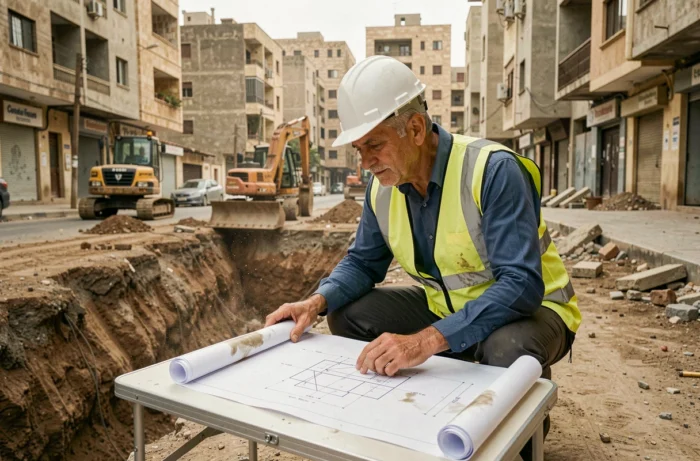
In practical terms, when an excavator opens a trench on Rue du 19 Mai 1956 or Place du 12 Mai, the discovery of archaeological remains can bring work to a halt for weeks. Algerian Law No. 98-04 of June 15, 1998, governs the protection of immovable cultural heritage and provides for public assistance mechanisms for preservation and restoration projects. We regularly follow La Gazette de Constantine’s construction updates to gauge the actual progress of these projects in the face of such constraints.
The on-site challenge is clear: every archaeological discovery requires a trade-off between the project deadline and the obligation to preserve the find. Contractors selected through the tender process must factor this risk into their schedules, which partly explains the recurring delays on projects of this kind in protected areas.
Rehabilitation of Constantine’s narrow streets: eight neighborhoods already completed
The wali of the Wilaya inspected the sites included in the redevelopment work on the narrow streets of the protected area. Work has already been carried out in eight neighborhoods: El Hadj Aïssa Ibrahim, Lahmar Ammar, Menaâ Makhlouf, Asselah Hocine, Benloucif Kamel, Sidi Lakhdar, Kedid Salah, and Rue Cheikh Benbadis.
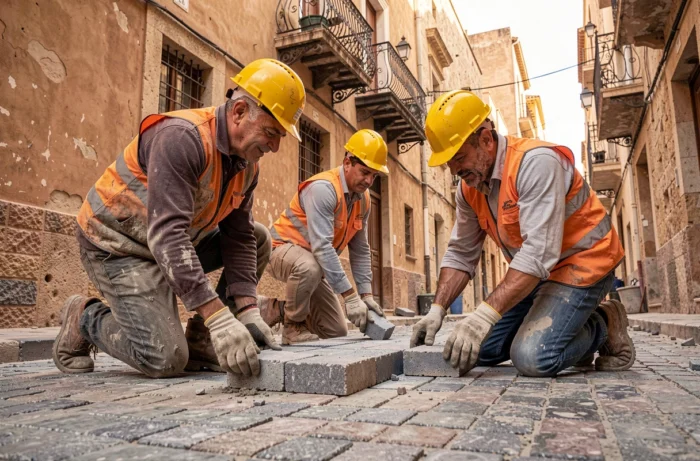
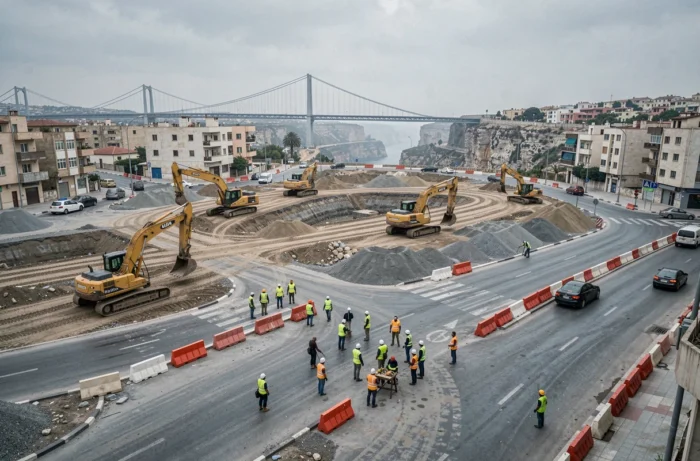
On the ground, the work involves resurfacing roads, repairing sewer networks, and bringing public lighting up to code. The old town’s narrow streets are inaccessible to heavy machinery. Much of the work is done by hand, with materials transported by wheelbarrow or carried by workers.
The streets included in Lot 05
The first contract package launched, designated “Lot 05,” targets several streets of significant heritage value:
- Rue du 19 Mai 1956, a busy commercial thoroughfare slated for complete resurfacing and renovation of the adjoining façades
- Place du 12 Mai, a pedestrian meeting point whose redevelopment aims to improve pedestrian flow and enhance its appeal
- Rue Ben El Moufok Omar, a lesser-known but strategically important street for easing traffic between the upper and lower towns
The stated goal is to reconnect the City of Bridges with its urban heritage, according to the Urban Planning Department. In practice, this means coordinating façade materials, removing unauthorized extensions, and restoring visual coherence to streets where each decade has left its own layer of haphazard alterations.
Urban rehabilitation projects: why some never get off the ground
One finding recurs in academic studies on Constantine: heritage designation does not guarantee that work will be carried out. Several previous projects stalled at the technical and financial study stage and never reached construction.
There are several reasons. Property in the old town is fragmented, with jointly owned buildings where every heir’s consent must be obtained before work can be done on a façade. Local construction companies do not always have the expertise required for heritage restoration, making it necessary to hire specialist design firms and extending procurement timelines.
The legal framework and public assistance
Law No. 98-04 provides for assistance schemes to restore immovable heritage. The practical question is who can access them. Private owners in protected areas may theoretically qualify for grants, but administrative procedures often discourage individuals from applying. How public assistance is coordinated with ongoing projects remains unclear and varies depending on the neighborhood and the type of building involved.
Construction work in Constantine: how rehabilitation affects residents
Beyond the official announcements, the effects on daily life are tangible. Neighborhoods that have already been rehabilitated now have better lighting, renovated water networks, and roads that remain passable in rainy weather—something that was not the case in some narrow streets, where runoff water used to pool because of inadequate drainage.
The program is part of presidential directives aimed at showcasing Algeria’s major cities and enhancing their historical, cultural, and tourist appeal.
Ongoing construction is also affecting traffic and local businesses. Shopkeepers on Rue du 19 Mai 1956 are experiencing access disruptions during excavation work. Balancing active construction with neighborhood life remains the most tangible challenge of this transformation—far more so than the budget figures announced in official statements.
Constantine’s rehabilitation is progressing in phases, with visible results in eight neighborhoods and work underway on six new streets. Archaeological risks, fragmented property ownership, and administrative complexity are slowing progress, but the first completed sections show that tangible change is underway in the old town.