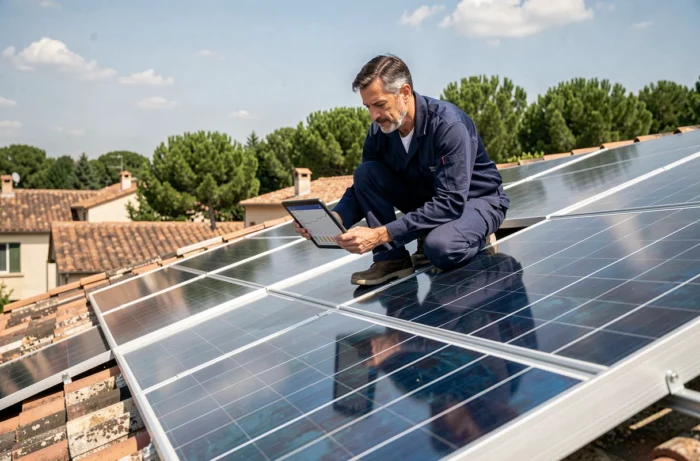
A photovoltaic panel converts sunlight into electricity through the photoelectric effect: photons strike silicon cells, releasing electrons, and an inverter converts this direct current into alternating current that can be used in the home. Generating your own solar electricity relies on this principle, but profitability depends less on the number of panels installed than on how the household uses the energy they produce.
Solar self-consumption and energy independence: two distinct concepts
These two terms are often confused, even though they measure different things. Self-consumption refers to the share of solar power used directly in the home as it is generated. Energy independence, on the other hand, indicates the share of the household’s total energy needs met by that power.
A household can have a high self-consumption rate (using almost all of its solar production on-site) while remaining heavily dependent on the grid in the evening and at night. Understanding this distinction helps avoid oversizing a system in the hope of achieving total independence, which panels alone cannot guarantee.
For more information on the different options for photovoltaic equipment and generation, see https://energiesolaires.fr.
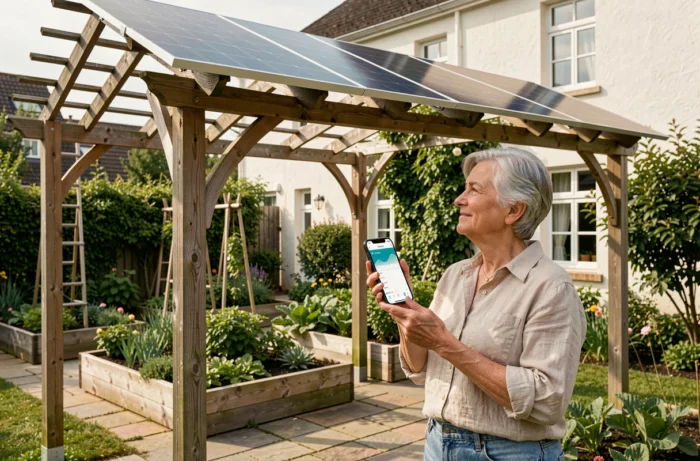
Shift electricity use to sunny hours
A kilowatt-hour of solar power consumed on-site is worth considerably more than one fed into the grid. Since Order S21 was published in the Official Journal on 4 June 2026, new complete grid connection applications submitted from 5 June onward have been subject to the removal of the self-consumption bonus and a sharp reduction in the surplus buyback rate. The gap between the price of electricity purchased from the grid and the price paid for surplus power has therefore widened further.
The direct consequence: every kilowatt-hour consumed while the system is generating is worth far more than every kilowatt-hour fed into the grid. Before adding equipment, the first step is to reorganize how the household uses electricity.
Which appliances to run during the day
- An electric water heater, often set to run overnight during off-peak hours, can be switched to a midday slot when the panels are producing at full capacity. This single change can use a significant share of the system’s output.
- Washing machines, tumble dryers and dishwashers are easy to schedule between 11 a.m. and 3 p.m. Their short but high-power cycles then coincide with peak solar production.
- Charging an electric vehicle during the day, when possible, is a major source of electricity demand that can absorb almost all the surplus.
- Pool pumps, ventilation systems and air conditioning naturally run during the sunniest hours, making them ideal for increasing self-consumption.
This daytime energy management requires no additional investment. In most cases, simply changing appliance schedules is enough.
Solar storage batteries: an investment to consider after optimizing usage
Home batteries are appealing because they promise to store excess daytime power for use in the evening. However, they remain expensive, and their lifespan is limited by the number of charge cycles.
Household energy use should be optimized before considering a battery. If, after shifting water heating, programmable appliances and, where applicable, vehicle charging, the surplus fed into the grid is still low, there is little left for a battery to store. The payback period then becomes very long.
A battery makes more sense in two specific situations: when the household has significant evening electricity needs that cannot be shifted, or when the goal is to maintain power during outages. Outside these situations, optimizing usage alone may be enough to deliver financial benefits.
Buyback rates and the electricity grid: what the June 2026 reform changes
Order S21 changed the financial terms for self-consumption with surplus power fed into the grid. The applicable scheme depends on when the complete grid connection application was submitted, not when the quote was signed. This distinction catches many homeowners off guard, as they assumed an earlier commitment would protect them.
Beyond its impact on individual households, this reform raises questions about how the electricity grid should be designed. Households with solar panels still rely on the grid to meet their needs at night and in winter. The grid remains necessary even for a self-consuming household, and the question of how to fairly share its costs between producer-consumers and conventional consumers is now being raised publicly.
Practical implications for a photovoltaic installation project
The lower buyback rate makes increasing self-consumption more attractive than aiming to sell power back to the grid. The system should therefore be sized to match the household’s actual consumption profile rather than to reach the maximum permitted capacity.
An audit of electricity consumption habits—hour by hour, if possible, using the smart meter—provides a reliable basis for choosing the system’s capacity. The goal is to align the production curve with the consumption curve, not to generate the maximum theoretical output.
Residential solar power remains a financially viable option, provided production is matched to actual usage. The number of panels matters less than the household’s ability to use the power they generate when they generate it.