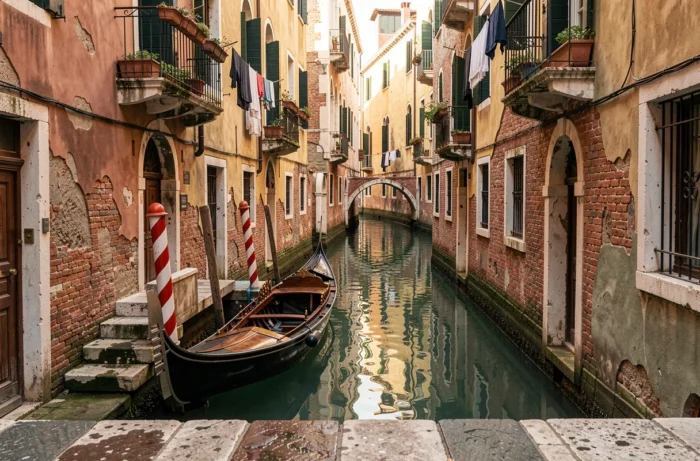
When you arrive in Venice at Santa Lucia station, the first thing that strikes you isn’t a monument: it’s the complete absence of roads. No sidewalks, no cars, no roundabouts. You step straight out onto the Grand Canal, and the city begins with water. This unique layout explains why Venice’s nickname, the City of Canals, is not a poetic image but a literal description of how the city works.
Venice’s canals as a daily transport network
People often think of gondolas and reflections on the water. To understand Venice’s nickname, you need to look at how the city actually operates: canals take the place of streets, avenues, and highways. Where a typical city has garbage trucks and delivery vans, Venice relies on cargo barges, waste-collection boats, and public transport boats called vaporetti.
Every urban service travels by water, from mail delivery to ambulances. People move house by boat. Building materials arrive on flat barges that navigate canals sometimes only a few meters wide. This floating logistics network comes with challenges residents manage every day: delivery schedules coordinated with the tides, boats sized to fit each canal, and precise maneuvers at aquatic intersections.
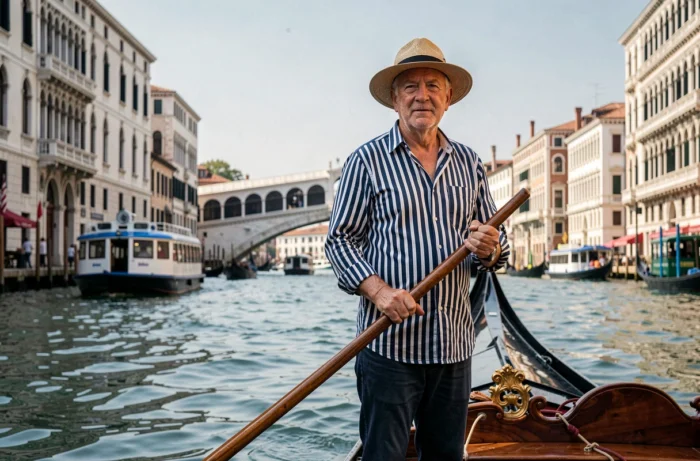
The Grand Canal, the main artery stretching for several kilometers, serves as a kind of ring road. The smaller canals, known as rii, function like neighborhood streets. You’ll see residents heading to work in motorboats, delivery workers supplying restaurants, and craftspeople transporting their tools. Canals are first and foremost places where people live, not just tourist scenery.
Why Venice was built on the lagoon
The city wasn’t built on water for aesthetic reasons. In the fifth century, the people of Veneto fled invasions by the Ostrogoths and later the Lombards. The lagoon, a marshy and hard-to-reach area, offered a natural refuge. The invaders were reluctant to venture into its shallow waters with their troops, and gave up pursuing the refugees.
These early Venetians reinforced the lagoon’s islets by driving millions of wooden piles into the mud. On these foundations, they built structures, dug navigation channels, and created an entirely water-based transport network. A hostile landscape became a defensive and commercial advantage.
Protected by water, the city prospered as a maritime republic for more than a thousand years. It developed a thriving Mediterranean trade, dealing in silk, spices, and other goods from the East. The Doge’s Palace, seat of Venetian power, still bears witness to the influence built on the lagoon.
Venice’s lagoon system, tides, and MOSE
Venice’s canals don’t form a closed network. They are part of a lagoon system connected to the Adriatic Sea through three inlets. This direct link to the sea explains the acqua alta, the high-tide events that regularly flood the city’s low-lying areas, particularly St. Mark’s Square.
To counter rising water levels, the MOSE mobile barriers were installed at the lagoon’s three inlets. When an exceptionally high tide threatens, the barriers rise and temporarily isolate the lagoon from the Adriatic. This changes how the canals function: water exchange with the sea stops, affecting internal currents and water renewal in the narrowest canals.
This infrastructure highlights a practical paradox. The canals need the sea to renew their water, but that same sea threatens to submerge the city. How often MOSE is activated depends on weather conditions and tidal coefficients, making every season different for residents and those navigating the inner canals.
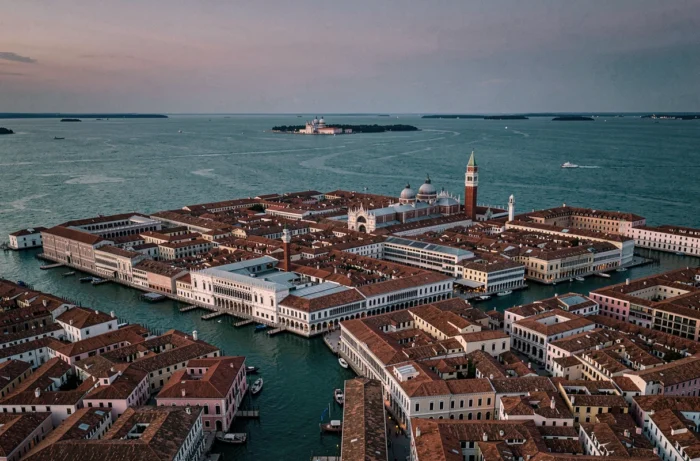
Venetian canals: tourist infrastructure or living spaces for residents?
Tourism has changed how some canals are used. On the Grand Canal, gondolas carrying visitors share the water with crowded vaporetti and water taxis. In the smaller canals of Dorsoduro and Cannaregio, neighborhood life is still visible, with residents using boats to run errands and make their daily journeys.
In 2024, Venice introduced an access fee for some day-trippers, reflecting the city’s efforts to manage visitor numbers as its resident population has been declining for decades. The details of the scheme vary by season, and the municipality adjusts its implementation schedule.
This tension between residential and tourist use is clearly visible on the canals:
- Delivery and service boats have to contend with tourist traffic, lengthening journey times for local businesses
- Some narrow rii, once used mainly by residents, are now also navigated by kayaks and small recreational boats
- Speed limits on the canals aim to reduce moto ondoso—the waves created by motorboats—which erode the foundations of historic buildings
Venetian canals embody this dual identity: a vital transport network for a shrinking community and a major attraction for millions of visitors each year.
Secrets and historic heritage along Venice’s canals
Traveling along the canals means passing through centuries of Venetian history. For centuries, the Rialto Bridge, which spans the Grand Canal, was the only permanent crossing between its two banks. The Bridge of Sighs, connecting the Doge’s Palace to the old prisons, takes its name from the sighs of prisoners who caught one last glimpse of the lagoon before being incarcerated.
Along the canals, Venetian palaces tell the story of the power of merchant families. Their façades face directly onto the water because the main entrance to a Venetian palace was by boat, not from the street. Water gates, openings at canal level, were used to unload goods and welcome distinguished visitors.
The lagoon itself is dotted with islands, each with its own story. Murano is known for its master glassmakers, who have worked there since the 13th century to keep the risk of fire away from the city center. Burano is recognizable by its brightly colored houses. Torcello, almost deserted today, was once one of the lagoon’s earliest settlements.
The City of Canals owes as much to its waterways as to what they made possible: a maritime civilization built on mud that turned its geographical vulnerability into the foundation of its power. The canals are not decoration. They are the city.