
A child’s vulnerability is not simply a matter of being small or inexperienced. It stems from a combination of biological, psychological and social factors that constantly interact, and understanding them is essential to any effective approach to protection.
Neurological immaturity and developmental windows in children
The prefrontal cortex, which governs impulse control, anticipating consequences and emotional regulation, does not finish maturing until the end of adolescence. Throughout childhood, the brain operates with incomplete inhibitory circuits. Children can perceive danger without having the neural capacity to calibrate their response.
This immaturity is not a flaw: it creates windows of brain plasticity during which learning is rapid and profound. The downside is that adverse experiences (violence, neglect, chronic stress) are also imprinted with greater intensity in developing neural networks.
Children are therefore vulnerable precisely because they are still developing. Their autonomic nervous system responds to stress disproportionately compared with an adult’s, and coping mechanisms (adaptation strategies) remain rudimentary before preadolescence. An in-depth resource on Frencheo and child vulnerability explores the biological and psychological dimensions of this inherent fragility.
Parental technoference and screen exposure: underestimated risks
Protecting children in the digital world is often reduced to the question of screen time. Research by Santé publique France highlights a less widely discussed phenomenon: parental technoference, meaning the disruption of parent-child interactions by an adult’s screen use. The problem is not just the child’s screen; it is also the parent’s.
Infants and young children learning to speak need eye contact, turn-taking and responsive reactions to their attempts to engage. Every interruption caused by a notification or scrolling reduces the quality of these exchanges. Everyday protection therefore begins with setting aside phone-free periods for undivided attention, rather than focusing exclusively on monitoring a child’s screen time.
For older children, parental controls preinstalled on devices sold in France provide a first line of technical protection. They do not replace dialogue or the gradual learning of online risks, but they establish a basic framework. Media literacy, which specialists recommend should not be left solely to families, complements this approach.
Reporting and protecting a child in danger: the role of 119
A major barrier to reporting is the belief that evidence is needed before raising the alarm. The Ministry of Solidarity and Health reminds the public that you do not need established proof to contact 119: a concern or worrying sign is enough. Professionals and members of the public do not need to investigate; they simply need to report their concern.
This clarification makes a difference for teachers, educators, neighbours and healthcare professionals. Too many situations go unreported because observers wait for certainty that will never come without a specialist investigation. The government campaign aims to make 119 a civic reflex, not a last resort.
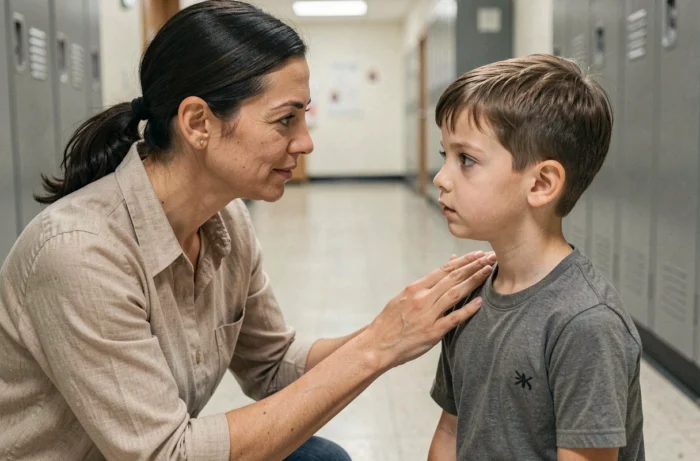
Professionals who work with children (in schools, after-school settings and healthcare) are legally required to report concerns. Their responsibility is not to diagnose abuse, but to pass on a combination of warning signs:
- Sudden changes in behaviour (withdrawal, unusual aggression, sleep problems reported by the child)
- Unexplained physical marks or inconsistent explanations from those around the child
- Things the child says, even if fragmentary or ambiguous, that suggest they may be in danger
- Repeated school absences without a credible explanation, alongside other warning signs
Cumulative vulnerability factors: why some children face greater risks
Children’s vulnerability is not uniform. It worsens as risk factors accumulate: factors that might be manageable on their own can combine to create systemic fragility. Financial hardship, housing instability and social isolation form a trio that amplifies each individual risk.
A child living in precarious housing is more likely to be exposed to harmful conditions (noise, damp and overcrowding) that affect sleep and health. If this hardship is compounded by limited access to a balanced diet, cognitive development is directly affected. And when a family is socially isolated, the support network that helps identify problems (neighbours, extended family, community organisations) is less effective.
We find that the most effective prevention programmes address this combination of factors rather than focusing on just one. School-based initiatives, for example, give children opportunities to talk to trusted adults outside the family, providing a safety net for those whose home environment is unstable.
Protecting children every day: practical steps that work
Everyday protection does not depend on a single measure, but on a combination of actions, habits and safeguards. Based on prevention experience, the following steps have been shown to make a measurable difference:
- Maintain regular opportunities to talk: set aside time each day for conversation (at meals, during journeys or at bedtime), when children know they can speak without being interrupted by a screen
- Name emotions with children from an early age so they have the vocabulary to express discomfort or describe an unusual situation
- Enable parental controls on devices and pair this technical measure with regular conversations about the content children encounter online
- Identify at least two trusted adults (other than parents) a child can turn to: a teacher, an extended family member or a friend’s parent
Protecting vulnerable children depends on a network of attentive adults rather than on any one person’s vigilance. Early reporting to 119, reducing technoference and addressing cumulative vulnerability factors all become more effective when they are part of a shared prevention network involving families, schools and the wider community.