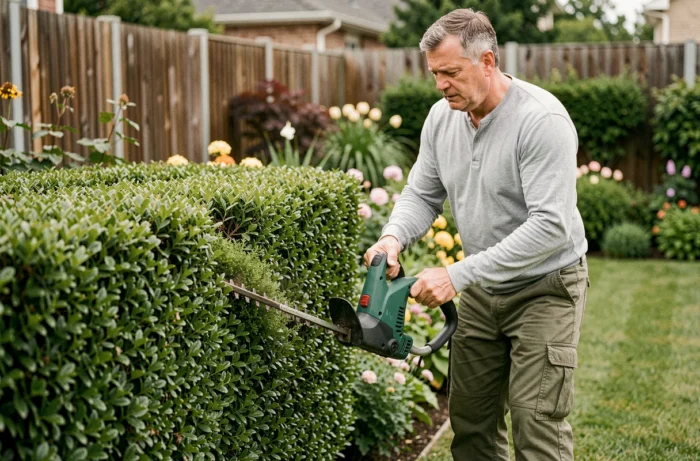
A privet hedge spilling onto the sidewalk, laurel branches blocking the living room window: an electric hedge trimmer can sort out these problems in just a few passes. But choosing between a low-cost corded model and a battery-powered tool that costs twice as much comes down to practical factors that go beyond the power rating on the label. Understanding what really sets these machines apart helps you invest in a tool suited to your hedge—not your neighbor’s.
Tooth spacing and cutting capacity: the factor product listings often overlook
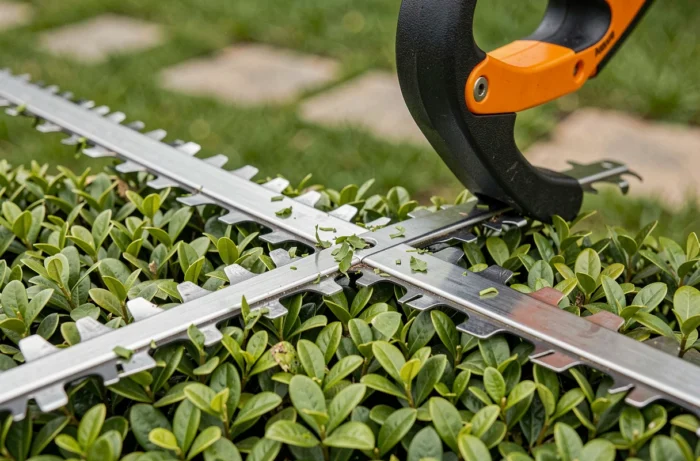
Most guides focus on motor power and blade length. But before you consider either of those, one factor determines how well the tool will actually perform: the spacing between the blade teeth. This determines the maximum branch diameter the trimmer can cut cleanly.
Narrow tooth spacing is suitable for young hedges or shrubs with fine foliage, such as boxwood or cypress. For a cherry laurel hedge that has been established for several years and has woody stems, you need wider spacing. If a branch exceeds the tool’s cutting capacity, the blade tears it instead of slicing through it. The result is damage to the plant that can encourage disease.
Have you noticed chewed-up branches after trimming? The problem is often unsuitable tooth spacing, not a lack of power. At taille-haie-electrique.com, product listings specify this feature for each model, making it easier to compare them.
Corded or battery-powered hedge trimmer: choose based on your garden layout
The choice between corded and battery-powered models rarely comes down to budget alone. The layout of your garden often makes the decision for you.
Corded models still make sense in certain situations
In a small garden with an outdoor outlet close to the hedge, a corded model is a very competitive option. It is lighter because it does not have a battery, and its power does not drop as you work. However, the cord means you need an extension lead, which makes trimming more difficult if the hedge is longer than about 15 meters or runs alongside a path far from the house.
Battery power gives you freedom of movement, but involves trade-offs
A battery-powered hedge trimmer eliminates the need to manage a cord. In return, battery life limits how long you can work without interruption. Two points are worth considering:
- Battery voltage directly affects cutting power. Higher-voltage models can handle thicker branches without slowing down.
- Weight increases with battery capacity. A high-capacity battery makes the tool heavier, which can tire your arms when trimming tall hedges.
- A battery system compatible with other garden tools (chainsaw, blower, brush cutter) means you do not have to buy a separate charger and battery for each tool. Several manufacturers offer this kind of compatibility.
For a long or sloping property, with hedges in several locations, a battery-powered model is the obvious choice. For a single low hedge near the house, a corded model remains a practical option.
Electric hedge trimmer weight and ergonomics: what really affects fatigue
Trimming a hedge takes time. Even a medium-sized hedge can mean holding the tool at arm’s length, sometimes above your head, for several minutes at a time. The total weight during use (with the battery attached, not the advertised bare-tool weight) therefore becomes a key consideration.
A lightweight but poorly balanced model can be more tiring than a slightly heavier one with its center of gravity close to the handles. Why does this matter? Because hedges are often trimmed vertically, with your arms raised. If the tool is front-heavy, your wrist has to compensate constantly.
Two ergonomic features make a real difference in everyday use:
- A rotating handle lets you adjust the blade angle without twisting your wrist, making it easier to trim the top of the hedge.
- An anti-vibration system reduces muscle fatigue during longer sessions. Even with an electric tool—which vibrates less than a gas-powered model—you can feel the difference after half an hour of work.
- An accessible start button that does not require you to change your grip helps you avoid awkward movements every time you resume cutting.

Hedge trimmer blade length: match the tool to the hedge height
A long blade covers more ground with each pass. A short blade is easier to maneuver around corners and rounded shapes. The right compromise depends on the hedge, not on an abstract preference.
For a straight hedge taller than shoulder height, a long blade reduces the number of passes and produces a more even cut. For topiary, a ball-shaped boxwood, or a low border, a short blade allows precise movements without the risk of cutting too much.
Blade length also affects weight and bulk. A tool with a long blade can be difficult to handle in tight spaces or between closely spaced shrubs. It is better to have two complementary tools than one that is poorly suited to half the job.
Noise and regulations: trim your hedge without upsetting the neighbors
An electric hedge trimmer is quieter than a gas-powered model. That does not exempt you from following the gardening hours set by your local authority. The French Public Health Code covers neighborhood noise that may disturb the peace because of its duration, repetition, or intensity. Permitted hours vary by local regulations: some municipalities prohibit powered gardening on Sunday afternoons, while others restrict the hours allowed on weekdays.
Checking local rules before you buy can also help you choose a quieter model if your garden is in a densely populated area. A battery-powered tool generally produces fewer decibels than a corded model with equivalent power.
The French Office for Biodiversity also recommends avoiding hedge trimming from March 15 to July 31, during the bird nesting season. Destroying the nest of a protected species is prohibited. An effective hedge trimmer is also one you know when to put away.