
A kitchen drawer that sticks, a room where the light falls awkwardly, a cleaning product that leaves a greasy film on the countertop: we spend hours in our homes without always knowing what’s wrong. Making your home work better and keeping it clean starts with fixing these everyday annoyances before thinking about décor or trends.
Indoor air quality: when cleaning pollutes your home
We rarely open the windows while cleaning, but that’s the first habit to change. Recommendations published by the Ministry of Health on Santé.fr advise ventilating during and after cleaning, following the recommended doses for cleaning products, and limiting sprays and scented diffusers, especially for people who are sensitive to them.
The most common pitfall involves homemade mixtures. “Natural” doesn’t mean risk-free: mixing bleach with an acid such as vinegar can release chlorine gas. Even homemade products should be labelled and stored out of children’s reach, and should never be mixed with anything else without checking first.
If you’d like to explore these topics further, Kafkaiens’ home advice covers everything from everyday cleaning to room-by-room design.
The Brittany Regional Health Agency (ARS Bretagne) describes four factors in cleaning: contact time, temperature, mechanical action and chemicals. Using fewer chemicals means increasing the other three factors. A damp microfibre cloth, used with a little elbow grease, can replace most all-purpose cleaners. A steam cleaner uses high temperatures to degrease a cooktop without any cleaning products.
Living room and kitchen layout: start with how you move around, not the catalogue
Most poorly arranged homes have the same problem: the furniture was chosen first, then squeezed into place. The reverse approach works better. Map out your everyday routes in your mind (or on the floor with masking tape): from the entrance to the kitchen, from the sofa to the dining table, from the hallway to the bathroom.
A main walkway should be wide enough for two people to walk side by side. If a piece of furniture encroaches on this route, it’s in the wrong place, no matter how good it looks.
Kitchen: the work triangle
The triangle connects the three main work areas: storage (fridge, cupboards), washing (sink) and cooking (hob, oven). Each side of the triangle should be no more than a few steps long. In an L-shaped kitchen, place the sink in the corner to shorten both sides. In a galley kitchen, position the sink between the fridge and the hob to avoid unnecessary back-and-forth.
Living room: build the room around a focal point
Putting the sofa in place first is a common mistake if you haven’t decided what it should face. Start by identifying the focal point: a fireplace, a large window or a textured wall. Then position the sofa facing it or at an angle. Place the coffee table within easy reach, without blocking the walkway.
Everyday surface care: choose the right method for each material
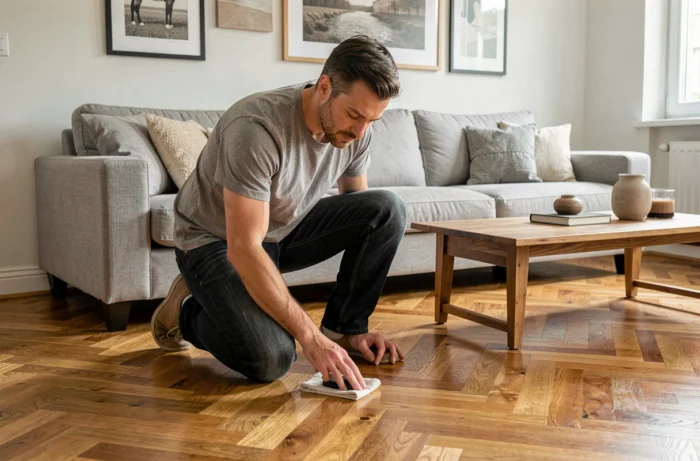
Scrubbing an oiled wood floor with the same product you use on porcelain tiles can damage it within months. Every surface reacts differently, and using the wrong cleaning method can cost more than the material itself.
- Oiled solid wood flooring: don’t let water pool on the surface; use a well-wrung mop that’s only slightly damp, and a specialist oil-based soap (not undiluted black soap, which strips the finish).
- Porcelain tiles: can be cleaned with hot water and a little diluted white vinegar, but porous grout absorbs concentrated acids and can deteriorate.
- Natural stone countertops (marble, granite): avoid all acidic products (lemon, vinegar); clean with diluted Marseille soap and wipe up grease stains immediately.
- Stainless steel (backsplash, sink): a damp microfibre cloth, wiped in the direction of the grain, is all you need. Abrasive sponges scratch the surface permanently.
Colour and natural light: two ways to transform a room without major renovations
Repainting a wall is one of the least expensive ways to completely change the feel of a room. The right shade depends above all on the room’s orientation. A north-facing room gets cool, bluish light, so warm shades (ochre, terracotta, yellow-toned off-white) help balance it out. A south-facing room can handle cool shades (sage green, grey-blue) without looking dark.
A common mistake is to test the colour on a small card held at arm’s length. Colours look different depending on the ambient light. Paint two coats on a patch at least 50 cm wide directly on the wall, then check how it looks at different times of day to avoid unpleasant surprises.
Layer light sources instead of relying on a single ceiling light
A central ceiling light illuminates a room evenly, flattening its features and creating little atmosphere. Layering three types of lighting adds depth:
- Soft general lighting (ceiling light or pendant), set to a moderate brightness.
- Focused task lighting (desk lamp, under-cabinet kitchen lights) for work areas.
- Ambient lighting (table lamp, string lights, indirect LED strip) that brings out corners and warms up the atmosphere in the evening.
With these three layers, you can adjust the lighting to suit the time of day without making any structural changes.
A comfortable home doesn’t require a huge budget or a complete renovation. The air you breathe, how easily you move around, the right care for each surface and well-balanced lighting matter more than a trendy piece of furniture in the wrong place. These small adjustments, made part of everyday life, are what make a home truly comfortable.