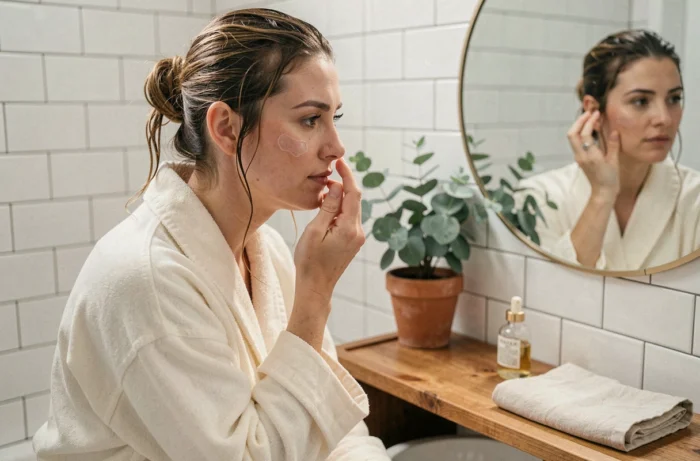
A shea butter cream that triggers contact eczema, a homemade oil infusion that turns rancid in two weeks, a “natural mineral” sunscreen applied too thinly to protect against anything: these are common pitfalls when switching to a so-called natural routine without first establishing a few clear guidelines.
Daily skincare with natural products can work, provided you distinguish botanical origin from skin tolerance and measurable effectiveness.
Allergens in natural cosmetics: what the European regulation changes
A common instinct is to avoid synthetic fragrances and turn to essential oils instead. The problem is that linalool, limonene and geraniol, which are widespread in natural formulas, are among the most common fragrance allergens.
European Regulation 2023/1545 expands the list of allergens that must be individually declared on packaging. Products placed on the market from August 1, 2026, must meet these new requirements, while products already in circulation may continue to be sold until July 31, 2028. Reading the INCI list remains the most reliable step before any purchase, even when the bottle is labeled “100% natural.”
In practice, turn the tube around and look for the Latin names of allergens rather than the word “natural” on the front. For more information on skin-friendly skincare and transparent formulations, visit https://www.belle-et-naturelle.fr.

DIY beauty recipes: what to know before you get started
Mixing honey, yogurt and a few drops of vegetable oil for a face mask works very well when used immediately. Problems arise when you make a batch for the week and store it in a jar without a preservative.
A homemade water-based preparation can develop mold within a few days, especially at room temperature in a humid bathroom. Commercial cosmetics, including organic products, contain preservation systems tested to ensure microbiological stability. At home, you have neither this level of control nor the equipment to verify it.
Three guidelines to reduce the risks
- Prepare only the amount needed for immediate use, and do not keep any leftovers for more than 48 hours in the refrigerator.
- Choose anhydrous recipes (without water): a blend of vegetable oil and a few drops of a well-tolerated essential oil keeps better than a gel made with fresh aloe vera.
- Never put your fingers in the jar: using a clean spatula reduces bacterial contamination.
The pleasure of making your own skincare should not make you forget that a simple recipe is not necessarily a safe one. A clay mask prepared just before use offers a good balance between a natural approach and risk management.
Sun protection in a natural routine: the step we tend to skimp on
It is easy to add a vitamin C serum or carrot oil to your daily beauty routine, thinking they will protect you from the sun. Neither ingredient can replace a sunscreen formulated with a measured SPF.
The European Commission’s recommendation on sunscreen products states that UVA protection should account for at least one third of the SPF. It also advises against claims such as “total protection” or “all day,” which create a false sense of security. An SPF 30 applied generously offers better protection than an SPF 50 applied too thinly.
How much to apply and how often
The same European recommendation specifies that applying too little sunscreen significantly reduces the protection achieved. For the face, aim for a line of product along two fingers. Reapply every two hours while exposed to the sun and after every swim.
Some mineral sunscreens (based on zinc oxide or titanium dioxide) are suitable for sensitive skin and fit into a natural routine. The deciding factor is not the origin of the filter, but measured UVA/UVB protection and the amount actually applied.

Natural facial skincare routine: the steps that matter morning and night
Once you have these precautions in place, your daily routine itself can remain simple: three steps in the morning and two in the evening, no more.
In the morning, cleanse your face with a gentle cleanser (a hydrosol or sulfate-free gel, depending on your skin type), apply a suitable moisturizer (vegetable oil for dry skin, aloe vera gel for combination skin), then finish with sunscreen. In the evening, remove makeup or cleanse your face, then nourish your skin with a few drops of jojoba, hemp or apricot kernel oil.
Adapt your routine instead of piling on products
The temptation is to add a serum, an essence, an eye cream and a weekly mask. The result is a cluttered shelf and skin that no longer knows what to absorb. Three products chosen to suit your skin type are better than eight bottles used sporadically.
- Oily or combination skin: a gentle cleanser with green clay, tea tree hydrosol as a toner, and non-comedogenic jojoba oil.
- Dry skin: a cleansing balm with sweet almond oil, a rich shea butter cream, and an avocado oil serum.
- Sensitive or reactive skin: a fragrance-free cleansing milk, chamomile hydrosol, and soothing calendula oil.
The effectiveness of a natural beauty routine should be assessed over several weeks. Consistent daily care produces more visible results than the occasional use of an intensive treatment. If a natural product does not suit your skin (tightness, redness or unusual breakouts), stop using it and observe your skin for a few days before replacing it, rather than adding another product to counteract the reaction.