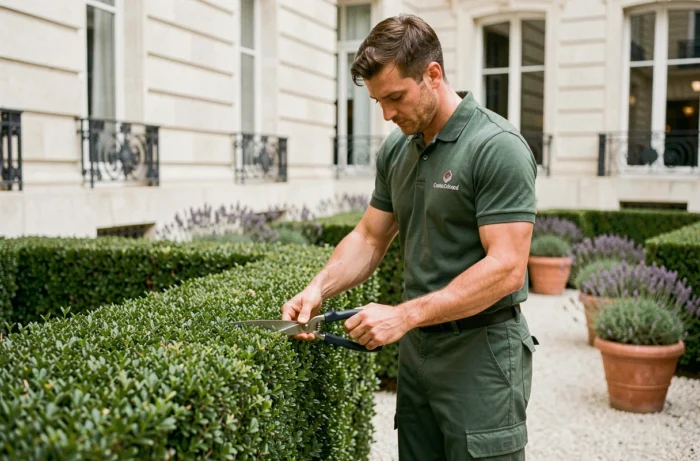
A balcony where plants struggle to grow, a shared courtyard where nothing takes root, a terrace you’d like to turn into a green oasis: in Paris, the need for a landscaping professional often arises in highly constrained settings. Limited space, co-ownership rules, planning regulations and difficult access for machinery all come into play. Choosing the right company isn’t simply a matter of comparing quotes by price per square metre. It’s first and foremost about finding the right skills for your specific situation.
Paris’s bioclimatic PLU: what your landscaper should know how to check
Since November 2024, Paris’s bioclimatic PLU has set rules for open spaces, unpaved ground and building greening. In practical terms, if your project involves a shared courtyard, roof or façade, certain greening requirements are now legally enforceable.
Have you noticed that some quotes don’t mention any regulatory constraints? That’s a red flag. A competent company checks the PLU before drawing up any plans. It identifies the plot’s unpaved-ground requirements, the biotope coefficients to be met, and whether a prior declaration or planning permission is needed.
When comparing several providers, ask one simple question: “Have you worked on a project subject to the bioclimatic PLU?” The answer will tell you more than a portfolio of photos. A landscaper who coordinates their work with planning procedures can help you avoid administrative hold-ups during construction—or even being required to restore the site to its original condition.
Among the landscaping companies in Paris, some clearly highlight their ability to handle regulatory requirements. It’s an effective way to narrow down your options, especially for co-ownership projects.
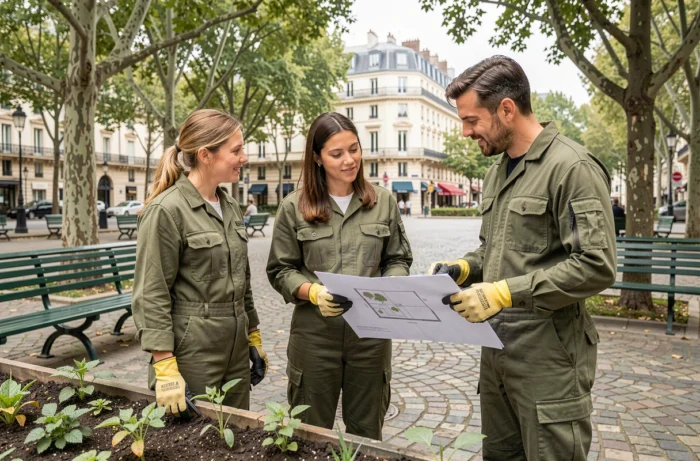
Practical criteria for assessing a Parisian landscaper
Online reviews offer an initial indication, but they’re not enough. A five-star review for a suburban detached-house garden doesn’t guarantee a thing when it comes to landscaping a terrace on the sixth floor.
Past projects matter more than promises
Ask to see photos of projects similar to yours. If you have a shared courtyard, look for a provider who has already worked in that kind of setting. A ground-level garden and a rooftop terrace require very different skills.
What to look for in a portfolio:
- A range of projects completed in Paris (courtyards, terraces, rooftops and small gardens), showing genuine experience of the city’s conditions and access constraints
- “Before and after” photos taken several months apart, proving that the plants have thrived over time—not just on the day the project was completed
- Verifiable references, ideally including contact details for a former client who is happy to answer your questions
The quote says a lot about how professional the company is
A detailed quote specifies plants by name, the type of growing medium, the planned drainage system and the maintenance arrangements. A vague quote that doesn’t specify materials often means corners are being cut on quality. Compare at least three proposals, checking line by line what is and isn’t included.
Items often missing from low-cost quotes include green-waste removal, a guarantee that plants will take root, and—most importantly—an irrigation plan. In Paris, access to an outdoor water supply is never a given.
Water management and de-sealing: an often-overlooked consideration
Why does this matter so much? Because summer droughts are becoming more frequent in Paris. In July 2025, a drought watch measure in Île-de-France called for reduced watering of green spaces. A landscape design that depends on intensive watering to survive isn’t a good investment.
Compare quotes based on their water-retention measures, not just the plants they include. De-sealing solutions such as swales, rain gardens and permeable growing media help manage runoff while supplying water to plants. These are practical solutions, not eco-friendly gimmicks.
Ask: “What happens if I can’t water for three weeks in summer?” The answer will help you tell apart a provider who plans for the long term from one who sells plants without considering whether they’ll survive.
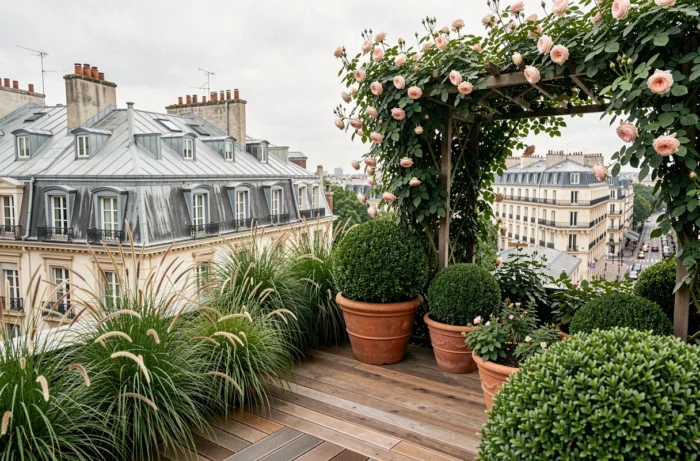
Green roofs in Paris: questions to ask before signing
A green roof is an appealing prospect. But whether it’s feasible depends on factors that only a technical assessment can determine. Structural load capacity, waterproofing, drainage and access for maintenance must all be checked before any planting begins.
A reputable company won’t start by showing you photos of flower-covered rooftops. It will first ask you to obtain a structural assessment—or carry one out itself. If a provider suggests laying down growing medium without checking your roof’s load-bearing capacity, look elsewhere.
Responsibility should also be clearly established. Who is liable if there’s a waterproofing problem after the work is completed? The contract must specify how responsibilities are divided between the landscaper and the other contractors (waterproofing specialist, architect). In Paris, co-ownership associations often require this to be clarified before approving the work at a general meeting.
Maintenance and follow-up after installation
A garden or terrace isn’t finished on the day it’s handed over. The first few months are critical for plants to take root. Check whether the company offers a regular maintenance contract and how much it costs. Some companies include one or two follow-up visits in their initial quote; others charge for everything separately.
A good rule of thumb: ask for the annual maintenance cost before approving the installation project. A beautiful landscape that’s too expensive to maintain can become overgrown within two years.
Choosing a landscaper in Paris means finding a professional who understands the city’s specific constraints: changing regulations, limited access, small spaces and water-management challenges. The cheapest quote is rarely the most cost-effective option over three years.