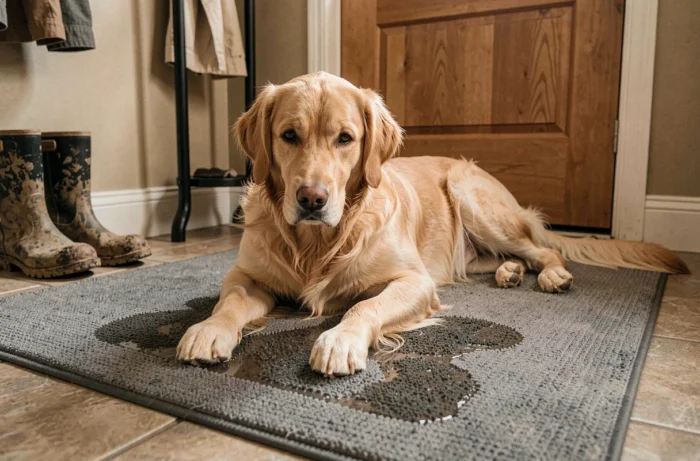
An absorbent dog mat serves a different purpose depending on whether it needs to catch water from paws after a walk or contain a puppy’s urine during potty training. Confusing these two uses means buying a product that won’t live up to its promises in everyday use. Choosing the right one comes down to specific technical criteria that most product listings fail to explain clearly.
Absorbent dog mats: microfiber versus waterproof backing—two distinct designs
A microfiber or chenille mat traps water and mud through capillary action in its fibers. Its open structure is designed to air-dry between uses. It is not intended to hold organic liquids for extended periods.
A potty-training mat designed to collect urine works differently. It combines an absorbent top layer with a waterproof PUL or TPU membrane that prevents liquid from seeping through to the floor. Without this barrier, the mat is simply a sponge on the floor.
Using a microfiber mat as a potty mat can allow moisture to seep through the fabric, leading to rapid bacterial growth on the floor covering. Conversely, placing a mat with a waterproof membrane by the entrance to wipe wet paws slows drying, since evaporation can only occur through the top. A absorbent dog paw mat suited to the intended use helps avoid these problems.
Absorbency and everyday drying: what product listings leave out
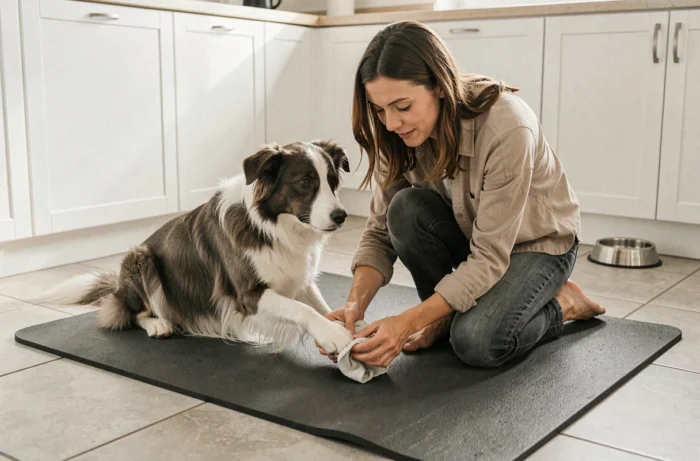
The label “ultra-absorbent” tells you neither how much liquid the mat can hold nor how long it takes to dry. In real-world use, a high-performance microfiber mat that works well after a rainy walk may be saturated after just the second or third consecutive use without washing.
Having a spare mat is a necessity, not a luxury. During several consecutive rainy days, one mat isn’t enough to keep the floor dry. Air-drying time varies depending on the fabric’s thickness and the room’s humidity.
Key features to check before buying
- Fiber density: a tight weave traps more water per unit of surface area, but takes longer to dry than a looser weave. The right balance depends on how often you go out
- Dryer compatibility: some mats can be tumble-dried on a low-heat cycle, cutting turnaround time in half or even by two-thirds compared with air-drying
- Non-slip backing: check that it can withstand repeated washing. Low-quality rubber coatings deteriorate after a few machine washes, and the mat loses its grip on the floor
- Whether it has stitched edging: without it, the edges fray quickly, especially if your dog scratches or chews the fabric
How to care for a washable absorbent mat: mistakes that shorten its lifespan
A machine-washable absorbent mat shouldn’t be washed like a bath towel. Fabric softener should be avoided: it leaves a coating on the fibers that gradually reduces their absorbency. Bleach causes the same problem, damaging the waterproof membrane on potty mats.
We recommend washing in cold or lukewarm water with a liquid detergent that contains no additives. An extra rinse removes detergent residue trapped in dense fibers. For mats with a PUL membrane, avoid tumble-drying on high heat: the heat can warp the waterproof layer and create tiny holes.
How often you wash the mat affects how long it lasts. A mat used daily by a medium-sized dog in an entryway needs to be washed at least once a week to remain effective. In bad weather, increase this to twice a week.
Mat size and placement: choose a format suited to the area
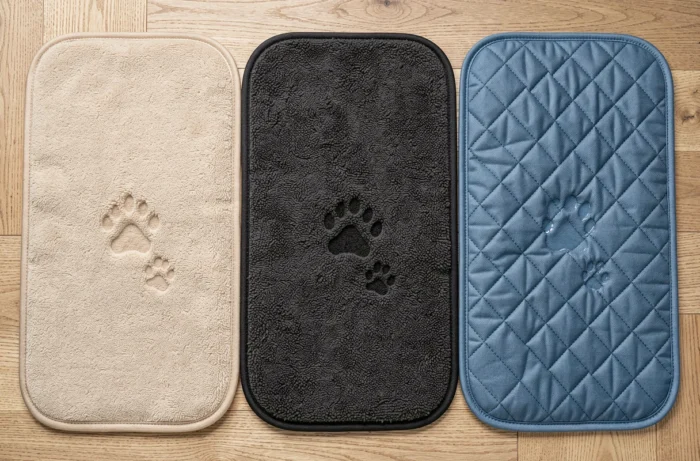
A mat that’s too small for your dog will catch only some of the water they bring in. The usable surface should cover at least the dog’s width with their paws spread, plus some extra room on either side.
Placement matters just as much as the product itself. If an entry mat is placed too far from the door, your dog will leave mud and water on the floor in between. Ideally, the edge of the mat should sit flush with the threshold.
Specific uses and suitable sizes
For the feeding area, a smaller mat with raised edges is enough to contain splashes. The main consideration is how easy it is to wipe clean, rather than deep absorbency.
For a puppy learning to use the potty or an older dog with incontinence, the mat should cover a larger area. A waterproof layer is essential, since the volume of liquid is far greater than that from wet paws. Washable models with elastic or folded edges help prevent leaks at the sides.
For everyday bedding, the distinction is between an absorbent mat and a comfort mat. A padded bed mat doesn’t need to absorb water, but it should withstand claws and frequent washing without losing its filling.
- Entryway: dense microfiber, non-slip backing, rectangular format suited to the width of the door
- Feeding area: compact size, easy-to-rinse material, raised edges or a lip
- Potty area (puppy or older dog): waterproof membrane, large surface, machine washable
Choosing an absorbent dog mat comes down to matching it to the type of liquid it needs to handle, how often it will be exposed to it, and how easy it is to care for. A mat that works well for the first week but becomes unusable after three washes isn’t doing its job. Checking that it’s machine washable, avoiding fabric softener, and rotating between two mats remain the most reliable ways to keep your home clean over time.