An engine that uses more oil than it did when new, brakes that squeal after a long period of inactivity, an M+S-marked tire rejected in a mountain area: these situations reveal maintenance gaps that most guides overlook. Looking after your car is about more than sticking to a service schedule. Good maintenance habits involve specific, often overlooked details that affect the vehicle’s mechanical lifespan and regulatory compliance.
Regenerative braking and corrosion: specific maintenance for electric vehicles
In an electric vehicle, regenerative braking recovers kinetic energy and slows the car without engaging the brake discs. As a result, the brake pads wear much more slowly. This may sound like an advantage, but it creates a genuine mechanical pitfall.
Because they are used less, the brake discs remain exposed to moisture and road salt without being cleaned by friction. Within a few months, a layer of corrosion builds up on underused discs, especially in regions where roads are treated in winter. Braking becomes uneven and noisy, and the vehicle inspection may flag the condition of the braking components.
We recommend regularly applying the brakes firmly at low speeds to mechanically clean the surface of the discs. Some newer models include an automatic brake-cleaning mode, but it often has to be activated manually in the vehicle settings.
Any work on the high-voltage system (traction battery, orange wiring) must be entrusted to a qualified professional. The electrical risk is real, and handling these components without proper training can cause irreversible damage to both the vehicle and the person working on it.
To explore these topics and other technical aspects of everyday vehicle use, Voiloo’s car advice covers a wide range of practical situations.
Winter tires and the Mountain Law: the 3PMSF marking is the only reliable guide
Tires must bear the 3PMSF symbol (a snowflake inside a three-peaked mountain) to qualify under the “suitable tires” option in areas covered by the Mountain Law. Otherwise, drivers must carry chains or snow socks that can be fitted to at least two drive wheels.
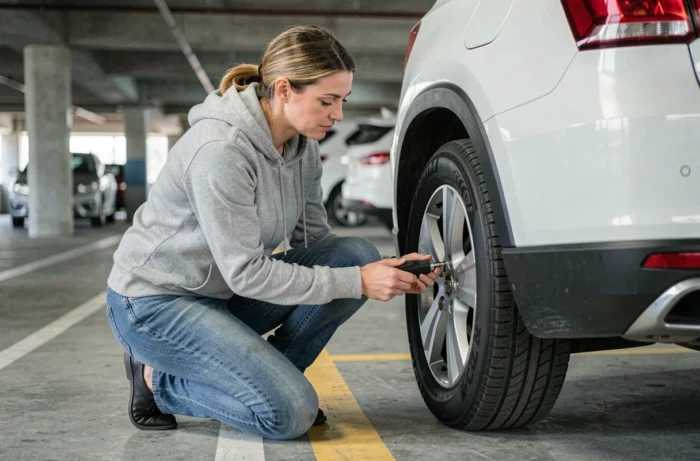
A common pitfall: many “all-season” tires still carry the M+S marking but not the 3PMSF symbol. Their owners assume they are compliant when they are not. Before each cold season, a quick visual check of the tire sidewall can prevent a fine.
- Check that the 3PMSF symbol appears on the sidewall of every tire—not just the M+S marking
- Make sure the chains or snow socks you carry are compatible with the size of your tires (the size may differ if you have changed your wheels)
- Check the local prefectural orders for your route, because the areas covered vary from one department to another and are not limited to Alpine passes
This is especially important for drivers passing through mountainous departments where they do not live. The law applies to locally designated stretches, sometimes including lowland roads at moderate elevations.
Vehicle inspections: what regional differences reveal about routine maintenance
Vehicle inspection pass rates vary considerably from one department to another. These differences cannot be explained by a single factor. The average age of the local vehicle fleet, climate conditions, the availability of garages, and owners’ maintenance habits all play a part, though it is impossible to determine the precise contribution of each.
This has a direct implication: a vehicle parked in a coastal area or a region with harsh weather ages differently from one kept in a temperate urban environment. Corrosion underneath the vehicle, the condition of the steering ball joints, and deterioration of the CV joint boots progress faster when road salt, moisture, or temperature fluctuations are involved.
Adjusting how often you check your vehicle to its actual environment, rather than sticking to the legal minimum, remains the most effective way to avoid a retest.

Engine oil and fluids: check them between scheduled oil changes
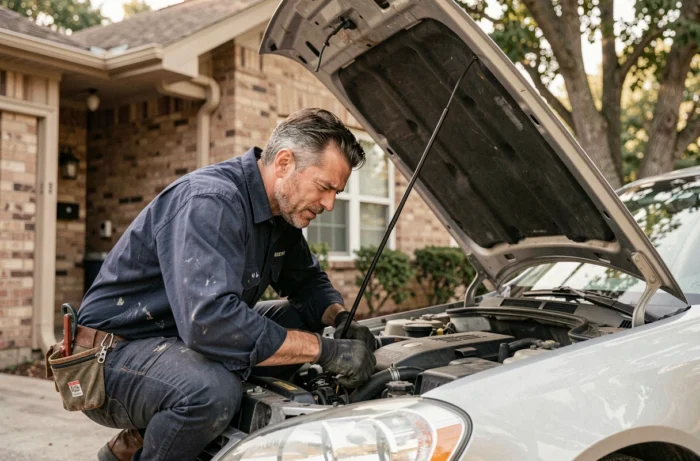
Following the manufacturer’s oil-change intervals does not guarantee that the oil level will remain correct between garage visits. A well-maintained engine naturally uses a small amount of oil, and consumption increases with mileage. Driving with a low oil level, even briefly, accelerates wear on the piston rings and bearings.
The dipstick (or digital indicator on newer models) should be checked at least once a month, with the engine cold and the vehicle on level ground. It is also a good opportunity to check the coolant and brake fluid—two fluids that can deteriorate unnoticed until a breakdown occurs.
- Brake fluid absorbs moisture over time, lowering its boiling point and reducing braking effectiveness during prolonged use (such as a mountain descent or spirited driving)
- Coolant loses its anticorrosion properties after several years, even if the level in the expansion tank remains stable
- Power steering fluid (in vehicles with hydraulic power steering) is often overlooked, even though a low level can cause noise and premature pump wear
12 V battery: the weak link in cold weather and in vehicles driven infrequently
The 12 V auxiliary battery remains the leading cause of breakdowns, regardless of powertrain. In both combustion-engine and electric vehicles, it powers the onboard electronics, locks, and the vehicle’s starting or wake-up system. A 12 V battery loses capacity without any obvious signs until one morning the vehicle will not start.
Repeated short trips, long periods of inactivity, and low temperatures accelerate battery discharge. A simple multimeter can measure the voltage when the battery is cold: a reading well below the nominal voltage indicates a worn battery whose remaining lifespan is rapidly shrinking.
For vehicles that are driven infrequently, using a smart charger with automatic shutoff to maintain the charge can extend battery life by several seasons. This simple step also prevents the clock and driving settings from resetting and, on some models, avoids the costly recalibration of electronic sensors after a prolonged power interruption.
Car maintenance is becoming more complex as powertrains diversify and regulations evolve. Checking your tires before driving in a mountain area, watching for brake corrosion on an electric vehicle, or checking your 12 V battery every fall are practical steps that protect both your vehicle and your wallet.