The awakening of curiosity in children relies less on the volume of activities offered than on the conditions in which the child explores. Multiplying directed workshops without allowing space for personal initiative has the opposite effect: the child waits for instructions on what to do. Structuring the daily environment to generate opportunities for spontaneous questioning remains the most effective lever.
Outdoor free play and child curiosity: what changes in the absence of instructions
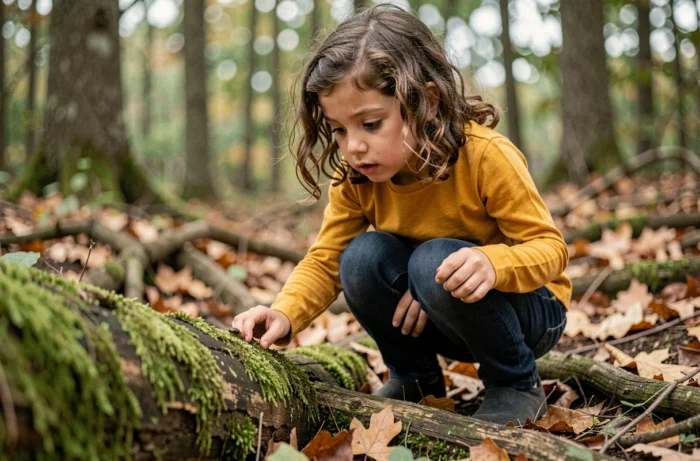
Child-initiated free play outdoors does not serve the same function as a structured activity. A report published by Terra Nova advocates for more opportunities for outdoor play where the child chooses what to do, rather than multiplying activities organized by adults.
The child who decides on their own play scenario engages divergent thinking. They formulate hypotheses (“if I throw this stick in the puddle, will it float or sink?”), adjust their actions, and try again. This loop of autonomous exploration does not occur in a setting where the adult assigns roles.
The same report notes that access to outdoor play heavily depends on the urban environment and the parents’ sense of security. In practice, we find that families with a garden or a nearby park naturally offer more free playtime than those living in collective housing without accessible green space. This is a variable to consider before prescribing “nature” activities: the primary issue is access to a suitable space.
To extend this reflection with concrete resources suitable for younger children, you can discover the children’s section on Excargot, which gathers ideas by age group.

Play libraries and open schoolyards: underutilized play spaces in daily life
Articles on awakening focus on what parents can do at home. They overlook a collective lever: local play spaces. Terra Nova suggests better promoting play libraries, strengthening parent-child welcoming spaces, and opening schoolyards on weekends.
A play library exposes the child to games they do not have at home. The rotation of materials creates a regular novelty effect without the family having to purchase anything. The child also meets other children of varying ages, generating situations of imitation and negotiation absent from the family setting.
Schoolyards on weekends: a familiar space used differently
The child who returns to their schoolyard on a Saturday morning rediscovers it without the constraints of recess. They can run longer, invent rules, and use play structures differently. The familiar space becomes a testing ground because the social context has changed.
This approach also reduces the organizational burden on parents. Finding a suitable place is as important as finding an activity idea.
Daily activities at home: prioritizing depth over variety
Offering a different activity every day tires the adult and prevents the child from delving deeper. A child who spends three days on the same dirt bin, varying tools and questions, learns more than a child who rushes through painting, modeling clay, and collage in one afternoon.
- The kitchen offers a field for direct observation: transformation of textures by heat, dissolution of salt in water, rising of dough. The child asks questions because the result surprises them, not because they are prompted to think.
- Sorting everyday objects (buttons, pebbles, caps) allows for categorization work without specific materials. The child chooses their own sorting criteria, revealing their internal logic.
- Observing the same tree or plant over several weeks establishes a habit of tracking. The child notices changes and spontaneously formulates cause-and-effect links with the weather or seasons.
The repetition of an activity over several days produces finer questions than constant novelty. On the first day, the child discovers. On the second, they test variations. On the third, they begin to formulate hypotheses.
Screens and children’s curiosity: rephrasing the question
Guilting parents over screen time does not work. Terra Nova emphasizes the importance of offering attractive alternatives, particularly outdoor free play, rather than sticking to moralizing messages. The relevant question is not “how much time in front of the screen” but “what does the screen replace in the child’s day?”
A screen that replaces free play eliminates opportunities for autonomous exploration. A screen that replaces passive waiting (waiting room, travel) does not deprive the child of anything they would have done otherwise. This distinction allows families to prioritize without guilt.
Creating concrete alternatives rather than prohibiting
Removing a screen without providing something in its place generates frustration. Having a bin of objects to manipulate, a drawing pad, or a simple bag of pebbles collected on a walk offers a natural transition. The child shifts to physical or sensory activity because it is available, not because they have been lectured.
- A basket of “treasures” (pine cones, shells, pieces of fabric) placed in the living room substitutes for the tablet reflex.
- Books accessible without asking for permission encourage the child to browse on their own.
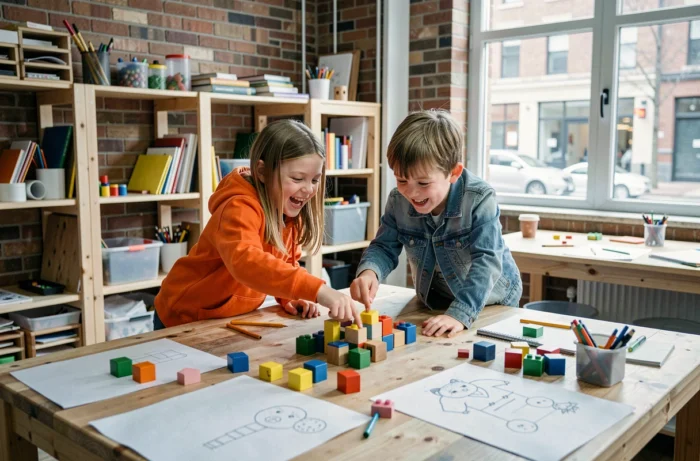
- A “craft” corner with cardboard, tape, and age-appropriate scissors is enough to keep them occupied for an hour without adult intervention.
The challenge for families is not to fill every minute with a playful idea but to make the home environment rich enough for the child to find ways to explore independently. A child who is bored in a well-equipped space eventually invents, and this is precisely where curiosity works.