
The size displayed on a box only describes a theoretical length. It says nothing about the volume, arch, or width of the forefoot. Choosing a men’s size based solely on the usual number exposes one to fitting errors that neither immediate comfort nor the durability of the pair can forgive.
Mondopoint and men’s sizing systems: what the charts don’t say
The European sizing system (EU) is based on the Paris point, an ancient unit of measurement. The UK system uses a different step, and the US system shifts the scale even further. These three references do not measure the same thing, and no conversion chart guarantees equivalence between brands.
There is a fourth system, Mondopoint, defined by an ISO standard and based on two actual measurements of the foot: length and width, expressed in millimeters. This system is used in certain standardized equipment (ski boots, safety shoes) because it describes the foot as it is, not as a commercial chart projects it.
For online purchases, the most reliable approach is to compare the measurement of one’s foot (in millimeters) to the chart specific to the targeted model, rather than mechanically converting a 42 EU to an 8 UK. The internal length of a 42 varies from brand to brand, sometimes by several millimeters, depending on the shape of the upper and the curvature of the sole.
This point is rarely explained in consumer guides, which present conversion tables as reliable equivalents. We recommend treating these tables as approximations, never as certainties.
Foot width and fitting volume: the criterion that size ignores
Two feet of the same length can require radically different widths. A narrow foot in a standard shoe floats laterally, causing friction and destabilizing the walk. A wide foot compressed in a narrow fitting generates stress on the metatarsals and promotes long-term deformities.
Some brands offer their models in several widths. Costume Privé Paris, for example, offers its oxfords in three widths (standard, wide, very wide) and advises measuring the circumference of the forefoot in addition to the length. This approach remains minority in common men’s shoes, where width often appears nowhere on the label.
To assess the width of one’s foot, the method is simple:
- Place the foot flat on a sheet, bearing weight (standing), and trace the outline with a vertically held pencil
- Measure the distance between the inner edge and the outer edge at the widest point of the forefoot, usually at the level of the metatarsophalangeal joints
- Compare this measurement to the manufacturer’s chart, when it exists, or opt for a wide-fitting model if the measurement exceeds the average of the standard chart
This measurement complements that of the length and allows for choosing a fitting adapted to the actual volume of the foot, which size alone cannot do. You will find additional references on standard men’s sizes on Style Papers, particularly to situate your own measurement relative to observed averages.
Measuring your foot to find your men’s size: reliable protocol
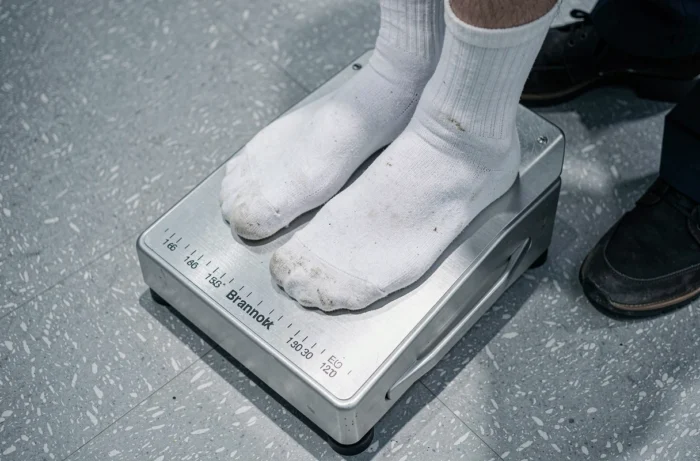
The measurement must be taken at the end of the day, with the foot bearing weight. The volume of the foot increases over the hours due to standing and heat. A measurement taken in the morning may underestimate the actual length by half a size.
Protocol:
- Stand on a rigid sheet placed on a hard floor, heel against a wall or a book
- Mark the tip of the longest toe (not necessarily the big toe: the second toe exceeds in a significant proportion of the population)
- Measure the distance from heel to toe in millimeters, then repeat the operation on the other foot
- Keep the measurement of the longest foot to determine the size
The difference between the two feet often reaches several millimeters. The size is always chosen based on the larger foot, even if it means adjusting the fit of the other foot with a thin insole or appropriate lacing.
Men’s size according to the type of shoe: running, city, boots
The size does not transpose from one type of shoe to another without adjustment. A running shoe incorporates extra space in front of the toes to absorb the foot’s roll during running. Counting about half a size more than in city shoes is common practice among runners, but this margin also depends on the thickness of the socks used.
In city shoes (derby, oxford, loafer), the fit is more snug. The leather stretches with wear, especially on full-grain calf models, and an initial excess volume will not be compensated. A slight tightness at the instep during fitting is normal on a new leather pair.
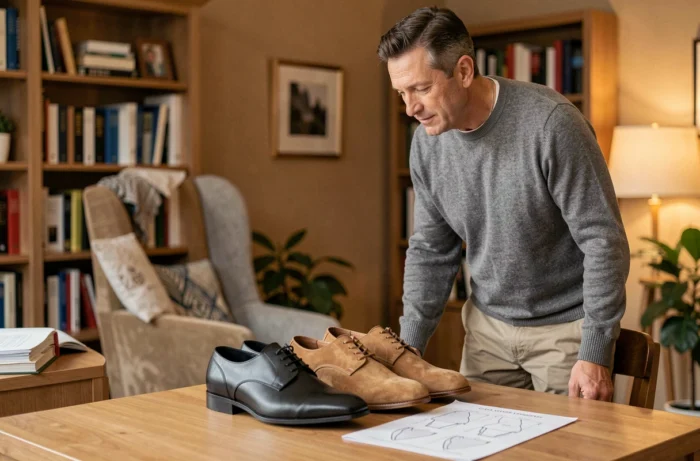
Boots and ankle boots rise to the ankle and constrain the foot differently. The vertical support sometimes compensates for a slightly more generous length fitting. The thickness of the sock (thin in the city, thick in hiking) also modifies the volume occupied in the shoe and may justify an adjustment of half a size.
Men’s fitting errors: recognizing an ill-fitting size
A pronounced diagonal crease on the upper, misaligned with the natural flex line of the foot, indicates a fitting that is too long. The foot slides forward, the heel lifts with each step, and the leather deforms prematurely in the wrong place.
Conversely, a toenail that darkens after a day of walking or persistent redness on the fifth metatarsal indicates a size that is too short or too narrow. These signals are not trivial: they reflect repeated compression that, over several months, can cause structural deformities of the foot.
The finger test behind the heel remains a quick indicator: if an index finger easily slides between the heel and the back of the laced shoe with the foot bearing weight, the size is probably too large. If no space remains, it is too tight. The ideal margin lies between these two extremes, with firm support without compression.
The men’s size is not a fixed number. It varies according to the brand, model, type of shoe, and even the time of day. Measuring one’s feet in millimeters, considering their width, and comparing this data to the specific chart of the targeted model remains the only method that truly reduces the risk of error.