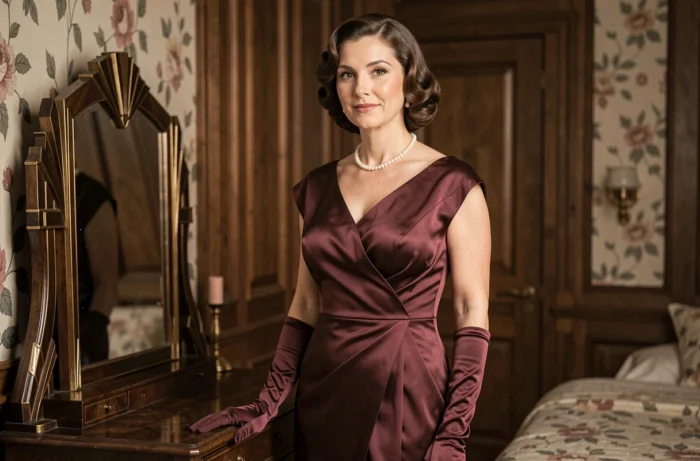
The bias cut, a technique of cutting the fabric on the grain at a 45-degree angle, defines the silhouette of the 1930s by itself. This decade marks a radical shift from the straight lines and low waists of the 1920s: fashion re-centers the waist to its natural position and lengthens skirts to the calf.
Bias Cut and Construction of 1930s Dresses
The bias cut exploits the natural elasticity of the fabric to hug the bust, waist, and hips without resorting to a corset. Silk crepe, satin, and chiffon are particularly suited to this technique because their fluid drape creates a flow that follows the movement of the body.
The waist returns to its anatomical place, often accentuated by a thin belt or a fitted seam. Skirts flare slightly below the hips, producing a trumpet silhouette characteristic of the decade.
This construction requires precise craftsmanship: a shift of just a few millimeters in the cutting angle can distort the entire garment. This is why modern reproductions often betray their origins with a too-stiff drape or an uneven hem, a point that guides on recognizing textile antiques detail extensively.
Fabrics and Fibers Available in the 1930s
The wardrobe of this era relies almost exclusively on natural fibers and the very first artificial fibers. Evening dresses use silk, velvet, and satin. For everyday wear, cotton, wool, and linen dominate, complemented by rayon (viscose) and acetate, the only manufactured fibers truly widespread at that time.
Nylon, often mistakenly associated with the 1930s, only enters commercial production at the very end of the decade. You can consult Ouvre Tête’s articles to delve into the distinctions between period fabrics and contemporary imitations.
Tweed, flannel, and thick wool are used for suits and coats. Patterns remain understated: polka dots, fine stripes, discreet floral prints. Shimmering fabrics are reserved for the evening, while muted tones (burgundy, navy blue, gray, forest green) dress the daytime.
Men’s Wardrobe and Children’s Clothing in the 1930s
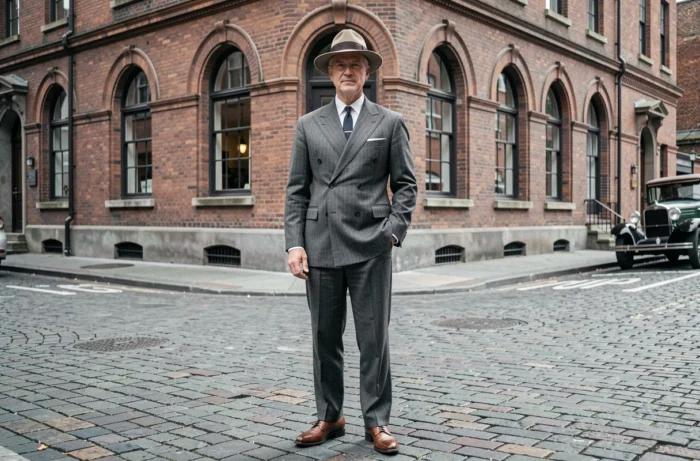
Articles on fashion from this decade almost always focus on women’s dresses. However, the men’s wardrobe deserves equal attention: the three-piece suit with broad shoulders and high-pleated trousers is the norm. The double-breasted jacket gains ground, and wide lapels become a stylistic marker of the decade.
Men’s hats (soft felt, fedora, straw boater in summer) are not just accessories. They serve as indicators of social status, profession, and context: going hatless remains frowned upon in most Western urban settings.
The Case of Children’s Clothing
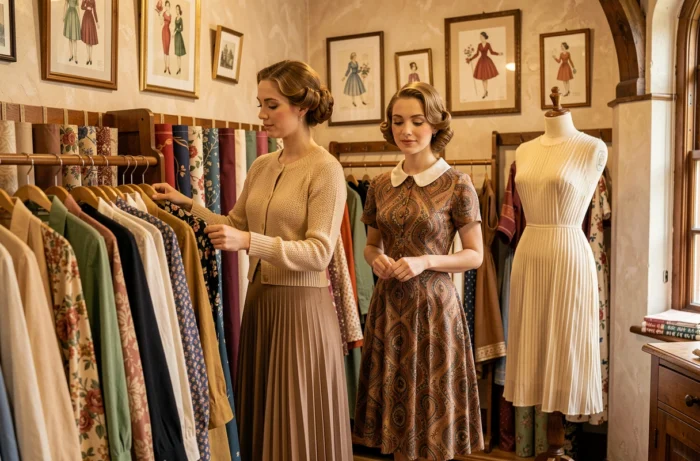
Boys frequently wear knickerbockers (cut below the knee) with long socks, a button-up shirt, and a sweater or vest. More formal outfits replicate the adult suit in miniature. Girls wear dresses with Peter Pan collars and pleated skirts, often made at home from patterns published in women’s magazines.
Head Accessories and Social Markers of 1930s Fashion
Women’s headwear in the 1930s evolves significantly from the previous decade. The deep cloche of the 1920s gives way to smaller shapes, worn tilted on the forehead or to the side:
- The soft beret, worn asymmetrically, becomes a daily classic and a symbol of chic relaxation.
- The fascinator (small hat with no brim or a very short brim) accompanies daytime formal outfits and signals a particular attention to appearance.
- The draped turban, popularized by Hollywood cinema, establishes itself as evening wear and marks a strong Orientalist influence in accessories.
Wearing an appropriate hat for the occasion remains a strict social convention for both women and men. The collections of the Metropolitan Museum of Art describe headwear as an expected element for any woman considered well-dressed during this period.
Influence of Hollywood Cinema on Fashion Styles
Hollywood serves in the 1930s as the main vector for disseminating trends, well before fashion magazines. The costume designers of the studios (notably those of MGM and Paramount) dress actresses whose styles are immediately copied by the general public.
Marlene Dietrich popularizes the male-female trousers suit, a silhouette that transgresses the gendered dress codes of the time. Jean Harlow imposes the white satin sheath cut on the bias, while Greta Garbo helps to popularize the long coat and beret.
This phenomenon has a direct consequence on the textile industry: the demand for patterns inspired by films explodes, and mass-produced clothing manufacturers begin to replicate silhouettes seen on screen. The decade marks the beginning of a mass fashion influenced by cinema, a mechanism that persists today.
Home Sewing and the Democratization of Patterns
The economic crisis pushes a significant portion of households to make their own clothes. Magazines publish detailed patterns reproducing the silhouettes seen in films or in Parisian haute couture collections. This parallel circuit explains why sophisticated cuts (bias, draping, raglan sleeves) find their way into modest wardrobes, made from cotton or rayon rather than silk.
- Butterick and McCall’s patterns widely disseminate silhouettes with a defined waist and long skirts.
- Inexpensive fabrics (printed cotton, rayon) allow for reproducing the overall look without the cost of noble materials.
- Domestic sewing becomes a common skill, passed down through generations and supported by practical sections in women’s newspapers.
The fashion of the 1930s is not limited to a glamorous style reserved for the elite. It is based on a constant tension between the elegance disseminated by cinema and the material constraints imposed by the crisis. It is this tension that produces the characteristic textile inventiveness of the decade, where the cut compensates for the lack of means and where draping replaces ornamentation.